
Who Invented School?
So you are wondering who invented school? The short answer is Horace Mann, who was a reformer from Massachusetts in the 19th century. Mann proposed the common school, a free, publicly funded school open to every child. His idea changed the history of American education and impacted the world.
However, you might be surprised to learn that there is not one person who invented school. Schooling has evolved slowly, just like our civilization, over the thousands of years we have existed as humans. For the first part of our history, informal learning took place in the home (during daily activities), in fields (when children would work alongside their parents), and in workshops (where parents would teach their children). As humanity began to form more complicated societies (ancient societies), so did the need for passing knowledge down for certain skills and jobs. There have been many ancient civilizations with their own formalized systems of education (Greece, China, India, and Egypt) long before classrooms or schools looked like we know them today.
Development of Compulsory and Standardized Education
The Rise of Government-Controlled Schooling in Europe
Historically, there has always been a way to learn or get an education, but until recently, it was generally unorganized and available only to some people. However, between the 17th century and the 19th century in Europe, it started becoming more common for governments to take a role in how children are educated rather than leaving education solely up to parents.
As governments began providing schooling for all children, they moved from simply providing public funds to providing support services for parents and their children. In addition to funding, schools were set up to ensure parents had all of the tools necessary to be successful in helping their children be successful, as well as having teachers who would work with them on a daily basis to ensure they both were able to succeed.
The Prussian Model: Who Shaped Modern School Systems?
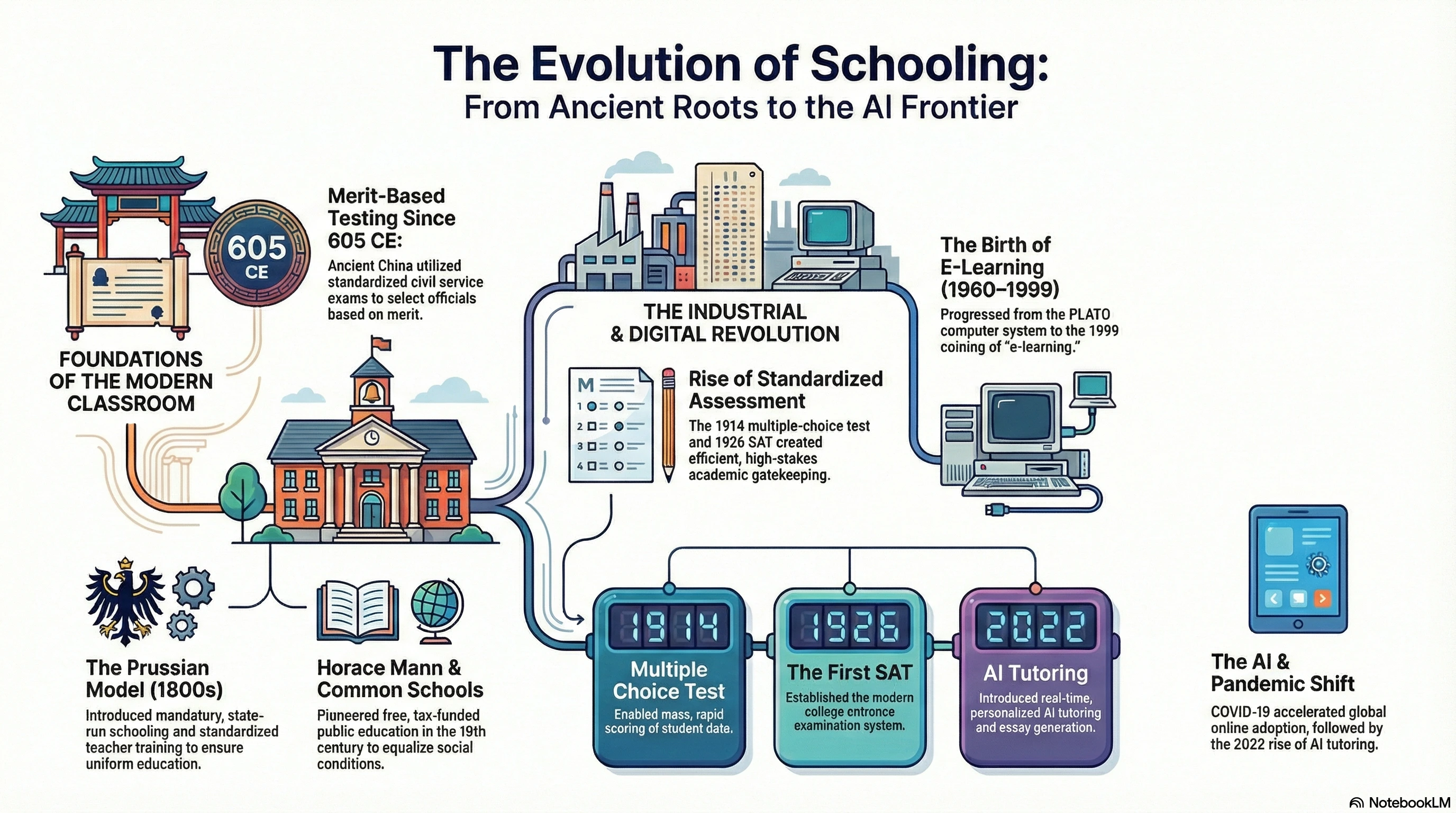
An important step in the public education movement can be traced back to the Kingdom of Prussia. In the 1800s, laws were created that required every child in Prussia to go to school and mandated that all children would be educated through a strong state-run educational system. The Prussian government provided cohesive policies for its school systems through strict guidelines regarding the education process.
For over 200 years, we have watched governments around the world follow the Prussian example with mandatory education for children and uniformity in their curriculum, discipline, and formatting schools. Teachers were no longer only local people who could read and write. The education system has pushed the status and designation of professionalism for teachers by establishing schools for professional training, so that the level of education was uniform from one location to another.
How the Idea of Common Schools Spread Worldwide
This model had a profound influence beyond its borders, and reformers from other nations studied it extensively. In the U.S., educational reformers like Horace Mann advocated for establishing common schools in the 19th century. The logic behind common elementary education is both simple and extraordinary; each child, irrespective of their background, will be able to access the same fundamental education that is financed through taxes.
Common schools were intended to give students a foundation in reading, writing, math, and civic education upon which to build higher levels of education. Over time, the concept became a broader public education system with clear standards, instructional materials, and guidance from school officials.
There were several factors leading countries to implement compulsory and standardized schooling systems. As countries became industrialized, they needed a workforce that was educated, punctual, and reliable. Countries that were developing their national identity wanted their citizens to be capable of communicating with each other through one common language, one common history, and one common identity. In addition, governments believed schools would help to eliminate poverty and economic inequality by providing, at a minimum, an education level of basic literacy as a means to support the well-being of their population.
Who Invented Assignments?
The story of modern education isn't just about where we learn, but how we measure that learning and how that learning is delivered. While the Prussian model gave us the structure of the classroom, the 20th and 21st centuries have been defined by two powerful, and often controversial, innovations: standardized testing and online schools. These technologies promised to make education more efficient, more objective, and more accessible, but their journeys have been anything but simple.
The History of Standardized Testing
The impulse to assess students is as old as education itself. In ancient China, as early as 605 CE, the imperial court used standardized exams to select civil servants based on their knowledge of Confucian philosophy. However, the modern, mass-produced standardized test is a creature of the Industrial Revolution, born from a desire for efficiency and data.

In the mid-nineteenth century, Horace Mann, who is now considered the father of the common school, was inspired by the Prussian educational system and wished to bring standardized tests to Boston schools. His objective was both to measure what students knew in a precise manner and make comparisons of the different school systems. His idea was quickly adopted throughout the United States.
Frederick J. Kelly invented the multiple-choice test in 1914, and it represented a technological advance in the field of testing by allowing for quick and easy scoring of tests. The efficiencies of multiple-choice tests were made abundantly clear during World War I, when the United States military utilized multiple-choice "intelligence tests" to sort through millions of new recruits into different military branches. Most importantly, the original forms of intelligence testing were not only defective due to their inherent flaws, but they were also created with a bias consistent with the cultural and social limitations of the creators. Therefore, one aspect of the history of intelligence testing illustrates an extremely dark side of the aforementioned history; the development of intelligence testing was closely tied to the eugenics movement, or the pursuit of scientifically validating the inferiority of certain racial and social classes as justification for the continuation of social classes.
Modern Testing: When did SATs Start?
After the Second World War, there was a tremendous increase in university entrance exams, which we now use today. The SAT was the first college entrance examination in 1926, and the ACT was established in 1959 as a competitor to the SAT; both became the gatekeepers of higher education. The scantron-type grading machine was invented in 1972, and the use of technology from the 1930's allowed these types of tests to be graded much faster and at a much lower cost than had been possible before.

The true beginning of high-stakes testing began in the late 20th century when the 1983 report titled "A Nation At Risk" stated that there was an education crisis occurring in America, and created the demand for greater accountability. This ultimately resulted in a number of federally mandated policies being enacted, including the No Child Left Behind Act of 2002, which established the requirement for annual reading and mathematics testing, and the Race To The Top program of 2009. Each of which tied test scores to funding for schools, evaluations of teachers, and eventually, whether or not a specific school would remain open. Critics of these pieces of legislation argue that they restricted the curriculum by forcing teachers to "teach to the test" and therefore created a punishment for under-resourced schools instead of simply creating a supportive environment for them.
Who Invented Distance Education and Online Schools?
The first step toward creating distance education began with the advent of the modern postal system. Sir Isaac Pitman, an educator from England, sent out assignments to his students using the postal service and instructed them on how to complete assignments using shorthand; he then received students’ completed work by mail and returned corrections to the students, resulting in Pitman becoming a pioneer of distance learning. The development of "correspondence schools" during the latter part of the 1800's until around 1910 also helped promote the distance education movement. The University of Chicago began offering correspondence courses in the 1890's, and private companies such as the International Correspondence Schools saw explosive growth in students enrolled in vocational and technical programs through correspondence courses.

The next major leap came with the computer. In 1960, the PLATO (Programmed Logic for Automated Teaching Operations) system was launched at the University of Illinois. It was the world's first computer-based training program and a true ancestor of modern online learning, allowing students to access coursework on large, centralized computers. The invention of the personal computer in the 1980s and the World Wide Web in 1989 brought this technology into homes and businesses, setting the stage for a dramatic expansion.
The 1990s brought about the development of Learning Management Systems (LMS) along with virtual learning environments; the term "e-learning" was coined in 1999. Distance education and online education were previously possible, demonstrated by the founding of the for-profit University of Phoenix (founded in 1976) and the UK's Open University (created in 1971).
In 2020, the COVID-19 pandemic served as the ultimate test of online learning, as schools were closed worldwide. Platforms such as Zoom, Google Classroom, and Microsoft Teams became the primary online classrooms for billions of students nearly instantaneously. This massive and sudden transition to online learning revealed issues with accessing digital technology for many students around the world. It also led to a global debate regarding the efficiency of online learning as well as the overall effects of online learning on the well-being of students.
Today, the frontier is artificial intelligence. AI is being used to create personalized learning paths, power intelligent tutoring systems, and even generate lesson plans. A new generation of AI chatbots, like ChatGPT (released in 2022), can now answer questions, write essays, and tutor students in real-time, offering both incredible opportunities and profound challenges for the future of teaching and learning. The dream of personalized education, first imagined by Plato's dialogues, may finally be within reach, though ensuring it remains a tool for teachers, not a replacement for them, is the critical task of our time.
Purpose and Importance of Schooling
- Academic Advancement. At its most basic level, schooling exists to build knowledge and skills. Students learn to read, write, calculate, analyze, and think critically. Academic advancement opens doors to higher education, specialized training, and professional careers. Without structured schooling, access to complex knowledge would be limited to a small segment of society.
- Communication and Language Learning. Schools develop strong communication skills. Through reading, writing, discussion, and presentations, students learn how to express ideas clearly and confidently. Language learning also plays a central role, whether mastering a first language or studying additional ones. Effective communication is essential not just for exams, but for relationships, careers, and civic life.
- Discipline and Good Habits. Beyond academics, schooling builds discipline. Showing up on time, meeting deadlines, completing assignments, and following rules help students develop responsibility and consistency. These good habits often carry into adulthood, shaping work ethic and reliability.
- Personality Development and Social Behavior. School is one of the first structured social environments children experience outside the home. It teaches cooperation, respect, empathy, and conflict resolution. Through daily interaction, students develop social behavior that allows them to function effectively in diverse communities. Personality development happens naturally as students discover their strengths, interests, and values.
- Leadership Quality and Confidence. Activities such as group projects, student councils, debates, and presentations encourage leadership quality. Students learn how to guide others, take initiative, and make decisions. These experiences build confidence and prepare young people to take on responsibilities later in life.
- Extra-Curricular Activities. Education goes beyond textbooks. Sports, arts, music, drama, and clubs play a major role in shaping well-rounded individuals. Extra-curricular activities promote teamwork, creativity, resilience, and time management. For many students, these experiences are just as formative as academic lessons.
- Social Advancement and Equality. One of the most powerful ideas behind public education was to “equalize the conditions of men,” a phrase often associated with 19th-century reformers like Horace Mann. The belief was that access to quality education could reduce inequality by giving every child, regardless of background, a fair chance to succeed. While education alone cannot eliminate social gaps, it remains one of the strongest tools for social advancement.
- Quality Education for a Stronger Society. Societies depend on educated citizens. Schools prepare future workers, leaders, innovators, and informed voters. Quality education supports economic growth, political stability, and cultural development. When education systems are strong, communities tend to thrive.
Notable Facts and Trivia about Schools
The history of schooling is full of details most people never hear about. For example, one of the earliest large-scale standardized testing systems began in imperial China during the Sui and Tang dynasties. These civil service examinations, which date back to 605 CE, were designed to select government officials based on merit rather than family status. In many ways, they were an early attempt to make education and opportunity more structured and competitive. Centuries later, similar ideas about merit and assessment would shape the development of schools in Europe and North America.
Another interesting shift happened in the United States during the 19th century. Early American schools often had a single teacher instructing students of all ages in one room. The now-familiar grade-level structure, organized curriculum, and age-based classrooms evolved gradually as the traditional school system expanded. Textbooks also became standardized over time, helping unify what children learned across different states. If you are curious about how scholars study these changes, publications like History of Education Quarterly regularly explore how curriculum, discipline practices, and public education policies developed over time.
It’s Amazing to see how technological advancements impacted schools and the classroom. From the point at which computers were first integrated into education in the late 20th century, students have changed the way they conduct research, write papers, and solve problems. When widespread access to the internet became available in the 1990s, students’ access to information increased exponentially. No longer were they confined to their local library or textbooks; they had direct access to knowledge wherever it was found. Online courses began appearing as universities and private companies started developing platforms for distance learning. Ultimately, what began as an adjunct to classroom education has often evolved to be a wholly separate method of educating students.
One fascinating fact about the modern academic year is that its length has its origins in the agricultural lifestyle. Contrary to popular opinion, the school year was not designed to allow children the ability to work on farms; rather, until the late 19th and early 20th centuries, school schedules were typically erratic, varying by urban/rural. With the implementation of standardized school schedules, all states progressively developed similarly scheduled school years, which contributed to improving curriculum delivery and better administrative coordination for all families within the state.

Comments (1)
Add Your Comment
That was an interesting read.